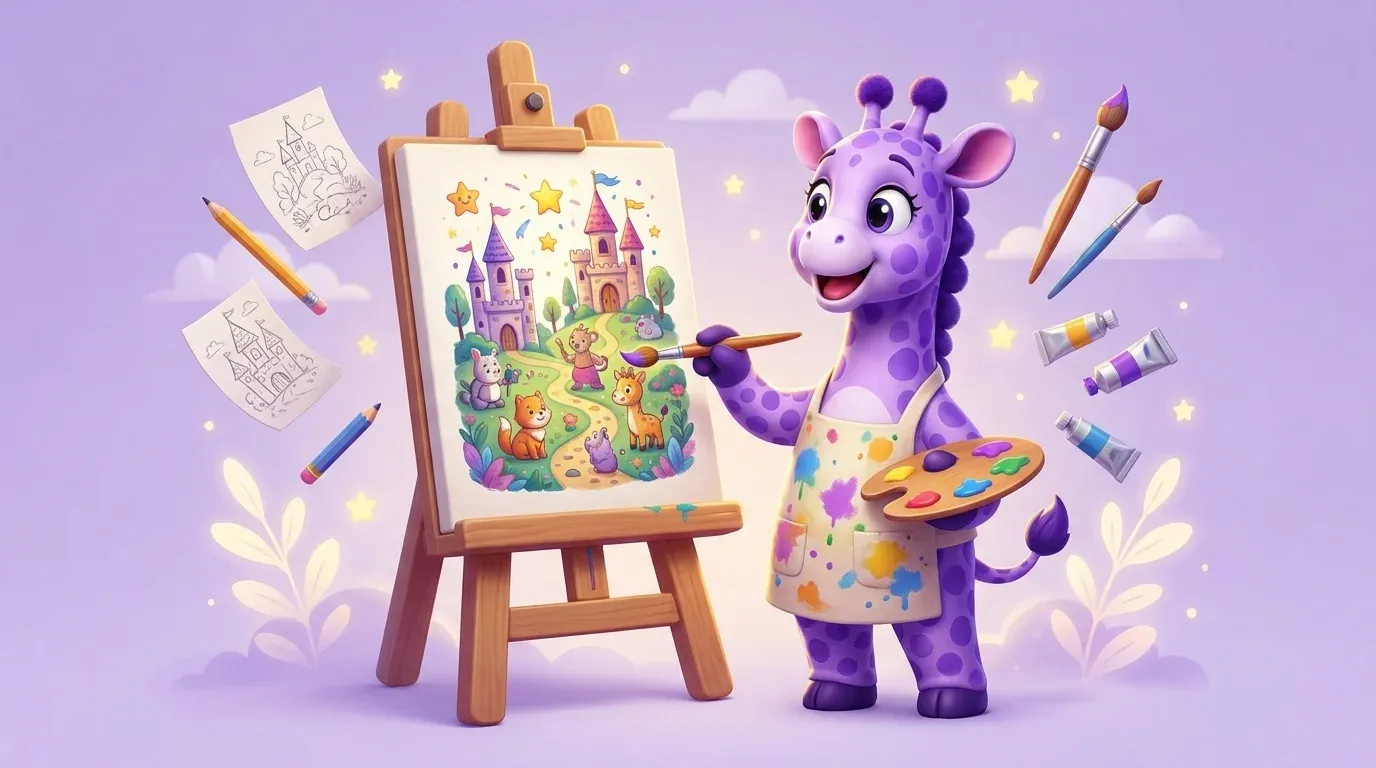
Picture a three-year-old who cannot read a single word, sitting perfectly still with a book open on their knees. Their eyes move across the page, they gasp at the right moment, and they turn to the next spread on their own. They are reading. Not the words, the pictures. For a young child, the illustration is not decoration around the story. It is the story.
That is why the choice of art matters so much, and why a generic image pulled off a stock library rarely does a children's book justice. A custom children's book illustration is built for your words, your characters and your reader. Here is what bespoke art actually does for a young reader, and why almost every story deserves it.
The quiet psychology of visual storytelling for kids
Long before children can decode letters, they are expert readers of images. A baby can follow a face. A toddler can tell a happy character from a frightened one by the set of its eyebrows. By the time a child reaches the picture book years, they are reading colour, body language, weather and space as fluently as an adult reads a sentence.
Good illustration speaks straight to that ability. It tells the child how to feel about a moment, sets the pace of the story, and answers the questions the words deliberately leave open. When art is made for the specific story, every visual cue lines up with the text. When it is borrowed from a stock library, those cues drift, and young readers feel the mismatch even if they cannot name it.
Pictures carry the emotion words cannot
A line like "and then the house went quiet" is just information. Pair it with an illustration of a small figure alone in a large, dim room and it becomes a feeling. That emotional layer is what makes children ask for the same book again and again, and it only works when the picture was drawn to match that exact line.
How illustrations affect reading comprehension and memory
There is a reason teachers reach for picture books to introduce hard ideas. When information arrives as both words and images at once, children have two routes to understand and remember it, not one. Educators sometimes call this dual coding, and it is one of the most reliable findings in how young minds learn. The picture gives the abstract word something concrete to hang on.
Strong illustration also lifts comprehension in a more practical way. A child who is not yet reading can follow the plot through the pictures, predict what happens next, and retell the story in their own words afterwards. That is real comprehension happening before the first word is decoded. Organisations such as Reading Rockets have long highlighted how central illustration is to early literacy, not a treat on the side of it.
- Images give children a second pathway to remember the story.
- Visual cues let pre-readers follow and predict the plot on their own.
- Matching art and text builds the link between pictures and meaning.
- Familiar, consistent characters make a book feel safe enough to revisit.
Custom illustration vs stock and generic art
The difference between bespoke art and an off-the-shelf alternative becomes obvious the moment you put them side by side across a whole book. Here is how they compare on the things that actually matter for a children's title.
| What matters | Custom illustration | Stock or AI images |
|---|---|---|
| Character consistency | Same face, clothes and proportions on every page | Drifts between images, breaking the spell |
| Match to your words | Drawn to the exact line, mood and page turn | Close at best, often slightly off |
| Style across the book | One coherent visual voice cover to cover | Mixed styles that compete with each other |
| Representation | Your characters, cultures and details, done with care | Generic and limited, hard to get right |
| Ownership and rights | Yours to keep and reuse across editions | Licences, limits and possible legal grey areas |
| Uniqueness | Art that exists for your book alone | The same image may appear in other titles |
Stock and AI art can look fine on a single page. A book is not a single page. It is twelve or more spreads that have to feel like one world, and that is exactly where borrowed images fall apart.
What bespoke art adds that a template never will
When you commission art for your story, you are not just buying pictures. You are building a character a child can recognise on sight, a setting they want to return to, and a look that becomes part of how the book is remembered. A custom illustrator can give a shy hero the same crooked smile on page two and page twenty, tuck small jokes into the background for the third read, and design every spread to pull the eye toward the page turn.
That craft is the heart of what our custom illustration team does, and it carries through to the cover, the piece of art that decides whether a browsing parent ever opens your book at all.
Lessons from picture books that worked
The most loved children's books in the world are inseparable from their art. Eric Carle's torn-paper collage made The Very Hungry Caterpillar instantly recognisable on any shelf. Maurice Sendak's wild creatures in Where the Wild Things Are are as famous as the words. Axel Scheffler's drawings turned The Gruffalo from a rhyme into a character children would know anywhere. None of those books would work with interchangeable stock images, because the art is doing half the storytelling.
If you want to see what the field considers its best, the Caldecott Medal has honoured outstanding picture book illustration for decades, and every winner is a study in art made for one specific story. You can also browse the range of styles in our own portfolio to get a feel for what bespoke work looks like across very different books.
A word from our art director
We asked Tom Beddoe, who leads the studio, what separates art that works from art that merely looks nice.
The first question I ask is never "is this pretty." It is "what is this picture doing that the words are not." If the answer is nothing, we redraw it. A custom illustration earns its place by telling the half of the story the text deliberately left out.
Tom Beddoe, Art Director, Purple Giraffe Press
Is custom illustration worth the investment?
Bespoke art costs more than a stock subscription. It is also the single thing most likely to make your book one a child carries around, asks for at bedtime, and remembers as an adult. For a book you may print, sell and be proud of for years, that is rarely the place to save a little and lose a lot. We quote illustration per project so the figure fits your story rather than a fixed list, and you can see how it sits alongside the rest of publishing on our pricing page.
If you are still weighing up the whole road ahead, our guide to publishing your first children's book walks through where illustration fits in the bigger picture.
Every story deserves to be seen
A children's book is a partnership between words and pictures, and a young reader meets the pictures first. Custom illustration is how you make sure the half of the story they see is as careful, as warm and as true to your idea as the half they hear. Stock art can fill a page. Only bespoke art can bring your particular story to life.
Ready when you are
Let's bring your children's book to life.
From a first idea to a finished book children adore, we are with you at every step. Tell us about your story and we'll reply within one business day.
Start Publishing →